
Balancing the Breath
The imbalances of prana show up as excessive speed, haphazardness, unrhythmicity and shallowness in breathing. These wrong breathing habits may further manifest as jerks and bursts of breath and imbalanced breathing between the two nostils.
The first step is to cleanse the respiratory tract and lungs by yogic kriyas in general and Neti and kapalbhati in particular.
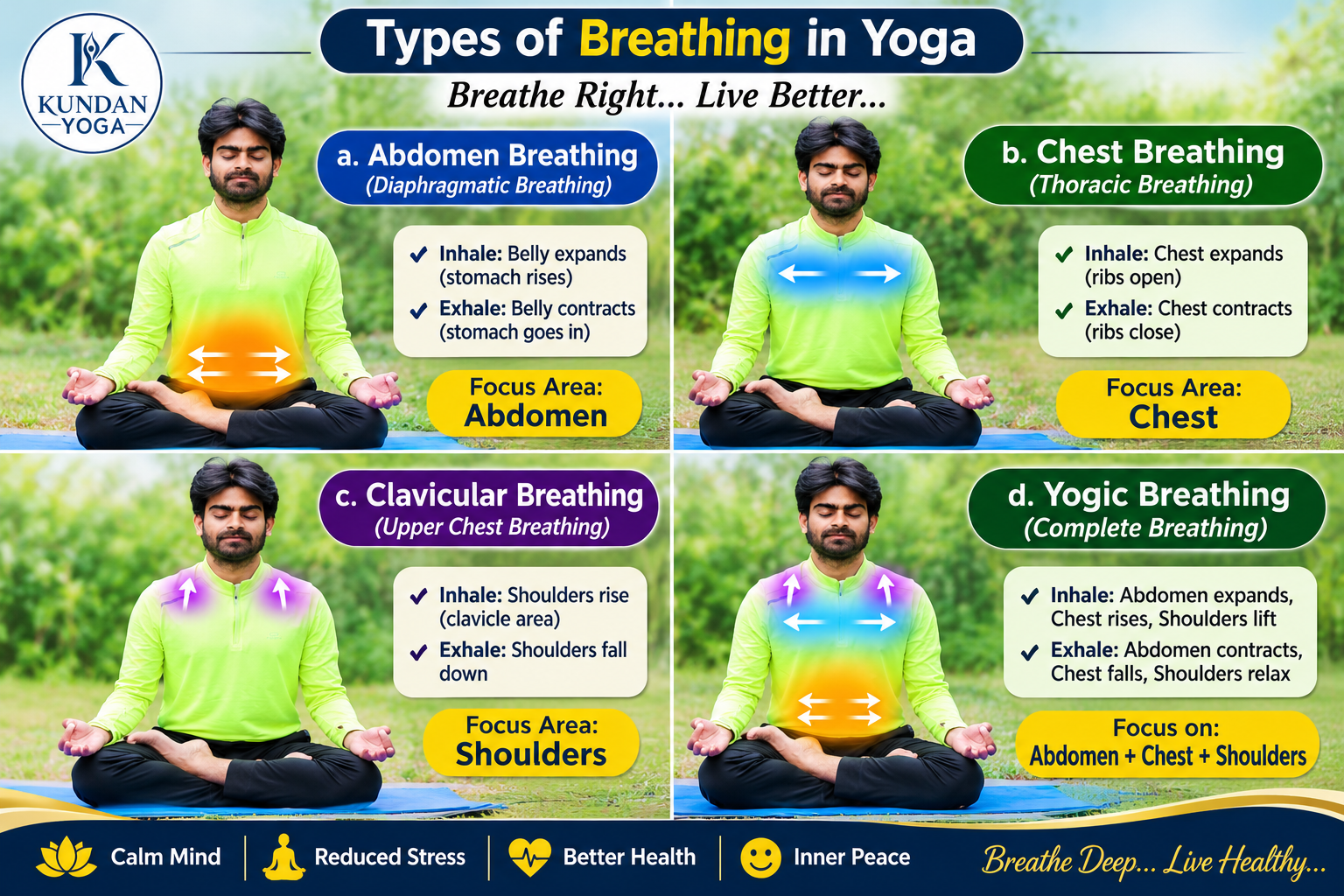
The second is to normalize breathing by decreasing the manifest of imbalances and correcting the wrong breathing habits. The techniques employed come under the head, “sectional breathing”. This is a preparatory breathing practice and increases the vital capacity of the lungs. It has three sections:
a. Abdominal or Diaphragmatic Breathing
b. Thoracic (chest) Intercostal Breathing
c. Clavicular or upper Lobar Breathing
d. Full Yogic Breathing
a. Abdominal or Diaphragmatic Breathing: Sit in vajrasana or sukhasana. Exhale and Enhale completely slowly and continuously. This is called puraka. The abdomen is made to bulge out continuously with the air entering into the lower sections of the lungs and hold the breath for few seconds comfortably. while exhaling (Rechak) the abdomen drawn inwards continuously. Before the breath is reversed, hold the breath for few seconds (bahyakumbhak) comfortably. Repeat the breath cycle without any force or jerk in the whole process.
This increases the air-flow into lower sections of the lungs.
b. Thoracic (chest) Intercostal Breathing: This sectional breathing is performed while sitting in vajrasana or sukhasana. Inhalation and exhalation are performed by expanding and contracting the chest only. Air flows through both nostrils slowly and continuously.
The middle lobes of lungs are opened up fully by this type of breathing.
c. Clavicular or upper Lobar Breathing: Sit in vajrasana or sukhasana. Raise the collar bone while inhalation and the shoulder backwards slightly. keep the abdomen muscles contracted. The air is forced into the upper most regions of the lungs thus ventilating the upper lobes while exhaling bringing down the collar bones and shoulders forward to normalcy.
The sparingly used upper lobes of the lungs will be properly aerated by this breathing.
d. Full Yogic Breathing: In the full yogic breathing technique, all the above three breathing types will be combined. During inhalation, the adhama, madhyama and adya occurs sequentially and during exhalation the same sequence namely abdomen (adhama), chest (madhyama) and clavicular (adya) breathing accur. The whole process should be relaxing and comfortable without any tension on the face.